Why Your Blush Never Looks Right — And the Simple Secret to Finally Getting It Perfect
Why Your Blush Never Looks Right (Even When You Try Your Best)
You buy a blush that looks beautiful in the store.
You apply it carefully, just like you’ve seen online.
Too bright.
Too dull.
Or it just doesn’t blend into your skin the way you expected.
It’s frustrating — especially when you’re doing everything right.
But the truth is:
- It’s not your technique.
- It’s not the product.
It’s your undertone. If your blush never looks quite right, it might be because you’re not choosing the right blush for undertones that match your skin.
What Undertone Actually Means (In Simple Terms)
Your undertone is the subtle tone underneath your skin — not the colour you see on the surface, but what’s sitting beneath it.
It doesn’t change when you tan.
It doesn’t change with lighting.
And it plays a big role in how colours look on your face.
That’s why the same blush can look soft and natural on someone else… but slightly off on you.
How to Figure Out Your Undertone
You don’t need anything complicated to figure this out.
A good place to start is your wrist.
Take a look at your veins in natural light:
- If they look slightly green → you likely have a warm undertone
- If they look blue or purple → you’re probably cool-toned
- If you can’t really tell → you might be neutral
It’s not an exact science, but it’s a helpful clue.
You can also notice what jewellery suits you more:
- Gold tends to flatter warm undertones
- Silver usually looks better on cool undertones
If both work, you’re likely somewhere in between.
Once you know your undertone, choosing blush becomes much easier.
Let me lead you by example. Below is a picture of my own wrist:
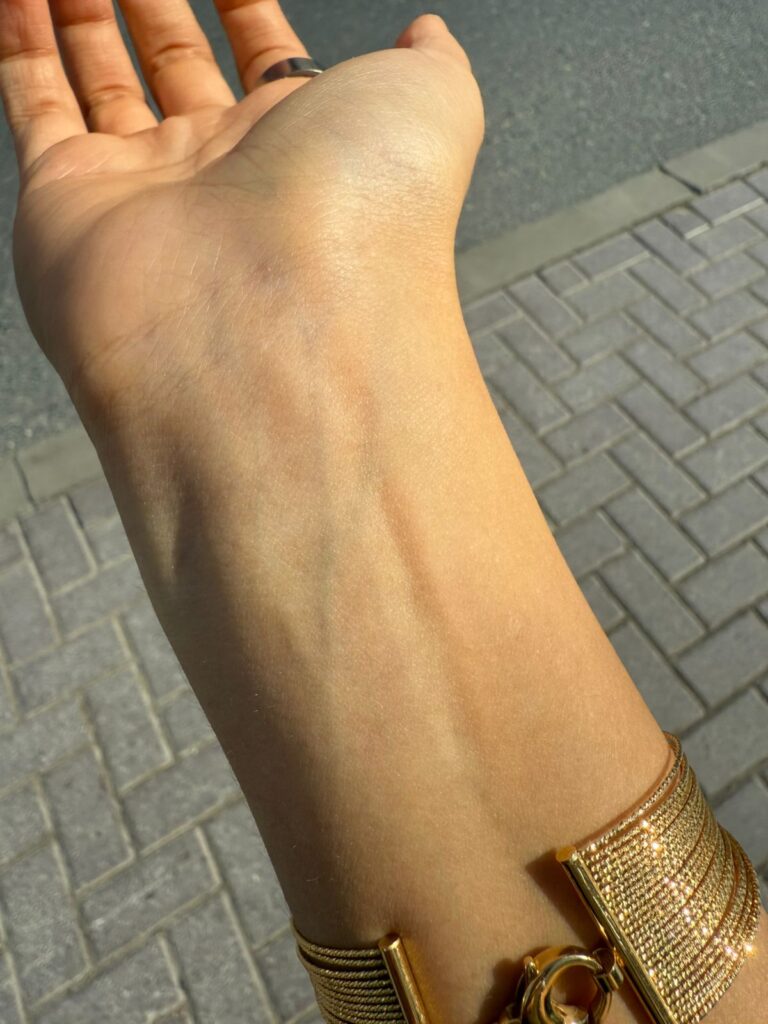
As you can see, the green in my veins is popping out although there are some blue hues towards my wrist. This means that I have neutral undertone leaning a lot more towards the warmer side. It is your turn now! Go out in some natural light, take a picture of your wrist and let me know in the comments about what you think your undertone is!
How to Choose the Right Blush for Your Undertone
Understanding colour theory can help you choose makeup shades that complement your skin tone.
If you have a warm undertone
You’ll usually find that softer, warmer shades sit better on your skin.
- Peach
- Coral
- Apricot
- Terracotta
These shades don’t fight your natural tone — they blend into it.
That’s why they tend to look more natural and effortless.
If you have a cool undertone
Cooler shades tend to feel more balanced on your skin.
- Soft pink
- Rose
- Berry
- Mauve
These colours mirror the natural tones in your skin, so they don’t look too orange or overpowering.
If you have a neutral undertone
You’ve got a bit more flexibility.
- Peach-pink
- Dusty rose
- Mauve
Most shades won’t look completely wrong — but softer tones usually look the most natural.
Why the Same Blush Looks So Different on Everyone
This is the part that confuses most people.
You see someone wearing a blush and it looks perfect.
You try the same one… and it just doesn’t work the same way.
That’s not your imagination.
Your skin tone — especially your undertone — slightly changes how the colour appears.
So even though it’s the same product, it won’t look identical on two different people.
It’s Not Just the Colour; The Formula Matters Too
Even if you pick the right shade, the formula can still change how it looks.
Some blushes sit on top of the skin.
Others melt into it.
If something keeps looking patchy or too obvious, it might not be the colour — it might just be the formula.
If you’re not sure what works best, it helps to understand the different types of blush and how they behave.
How to Actually Get It Right
You don’t need to overcomplicate this.
Start simple:
- Pick shades that feel close to your natural flush
- Apply a small amount first
- Build it up slowly
And most importantly, pay attention to how it looks on your skin, not someone else’s.
If your blush still doesn’t look right, it might also be worth looking at your skin type and how products sit on your face. If you’re not sure where to start, learning And if your blush still doesn’t sit well on your skin, it could be down to your skin type, in that case, it’s worth understanding the best blush for different skin types and what works best for you. can make a bigger difference than you think.
Do Undertones Change?
This is something a lot of people wonder about.
Your skin tone can change — especially with sun exposure.
You might get lighter in winter and darker in summer.
But your undertone stays the same.
So even if your shade changes slightly, the type of blush that suits you usually doesn’t.